
Summary
Texas is both a place where native-born residents tend to remain and a destination for millions of people arriving from elsewhere in the United States and around the world. The article argues that the state’s future may depend not simply on attracting industries such as artificial intelligence, quantum computing, semiconductors, energy and commercial space, but on attracting and retaining the people whose knowledge and relationships connect those industries. Drawing on the Port of Houston and Texas Southern University, it shows how infrastructure and human capital can create economic value that extends far beyond a single institution or location.
Who Is Becoming a Texan?
By Mustafa Tameez
SEP 01, 2026
I moved to Houston in April 1994.
For the first six months, I did not like it very much.
Houston’s economy was still recovering. In Southwest Houston, I remember shopping centers with more empty storefronts than businesses. Then there was the heat, the humidity, and those enormous flying cockroaches.
The flying cockroaches were unbelievable.
But something changed after I got married. Houston stopped feeling like the place where I happened to be living. I claimed it as home.
In 2010, I began traveling to Washington two or three times a month. My firm had just secured a place on the federal government’s GSA Schedule, and I intended to build a federal practice.
A few close friends and advisers told me I should move to Washington. That was the only way to build the business, they said. You had to be there.
Around that time, a close friend described Washington as a transient city. People came with an administration, worked on Capitol Hill, or built their résumés, then moved on to whatever came next.
The description was incomplete, of course. Washington also has generations of families who were born there and never left. But I understood what my friend meant.
I remember sitting on a bumpy flight back to Houston and turning the phrase over in my mind.
Why would you move to a transient city to build something?
Years earlier, on a similar flight, I had decided that Houston was where I was from.
On this one, I decided I was never leaving.
A Census-based analysis covering 2013 through 2017 found that only about 29 percent of the adults living in Washington were born there. That certainly fit its reputation as a city of arrivals.
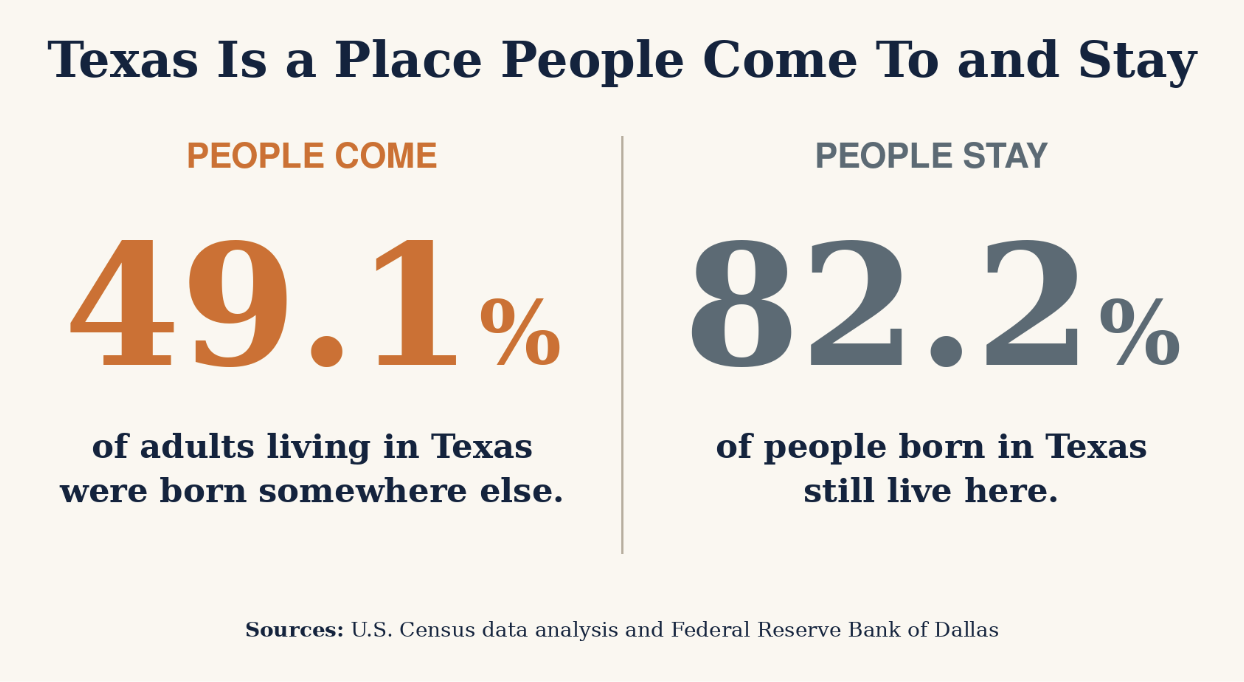
But in 2022, only about half of the adults living in Texas had been born here.
That surprised me.
Washington and Texas are both filled with people who began somewhere else. Yet they do not feel the same to me.
Perhaps the difference is not arrival. It is what people imagine they are arriving to do.
Texas is approaching an almost even demographic balance. In 2022, about 51 percent of its adults had been born in the state. Roughly 27 percent were born elsewhere in the United States, and nearly 23 percent were born in another country.
I am part of that second group.
Texas also retains an unusually large share of the people born here. In 2021, more than 82 percent of people born in Texas still lived here. It is simultaneously a place people are reluctant to leave and a place millions of others choose to enter.
That raises a question the Census cannot answer.
When does someone living in Texas become a Texan?
Texas has faced some version of that question throughout its history.
People came for land, agriculture, oil, military bases, universities, medicine, aerospace, trade, and opportunity. Their experiences were not equal, and not all movement was voluntary. Any honest history must account for Indigenous dispossession, slavery, segregation, and the people whose labor created wealth they were not allowed to share fully.
Still, successive generations of arrivals helped build the farms, railroads, ports, refineries, medical institutions, universities, and cities that changed the state.
In 2006, I learned how far the influence of one of those institutions could extend.
I worked on the Port of Houston bond effort with Jim Edmonds, who was then chairman of the Port Commission.
Jim was what I had come to think a real Texan should be. He was gracious and warm, and he cared deeply about the port and the region it served.
The economic impact study we used in 2006 estimated that port activity supported approximately 785,000 jobs across Texas and generated nearly $118 billion in statewide economic activity.
The size of those numbers surprised me.
Later studies have measured the Houston Ship Channel’s economic reach on a much larger scale.
The ships were in Houston, but the economic activity did not remain near the water. It moved through refineries, manufacturing plants, rail lines, warehouses, trucking companies, farms, stores, and communities across Texas.
The port occupied one place. Its influence reached almost everywhere.
Jim died years later. I still think about him. I still miss him.
The institution outlived him, but some part of what he cared about remains embedded in it.
More recently, my work with Texas Southern University showed me another way that influence travels.
An economic analysis estimated Texas Southern’s annual regional impact at approximately $1.6 billion. The most revealing finding was not what the university or its students spent.
More than 80 percent of the impact came from alumni.
The university’s greatest economic contribution walks out of its classrooms. Graduates become educators, business owners, health professionals, public servants, researchers, and employees. Many remain in the region. Their education continues creating value long after they leave campus.
The Port of Houston showed me how infrastructure can spread value across distance.
Texas Southern showed me what happens when people stay.
Those two lessons have shaped how I look at what is forming in Texas now.
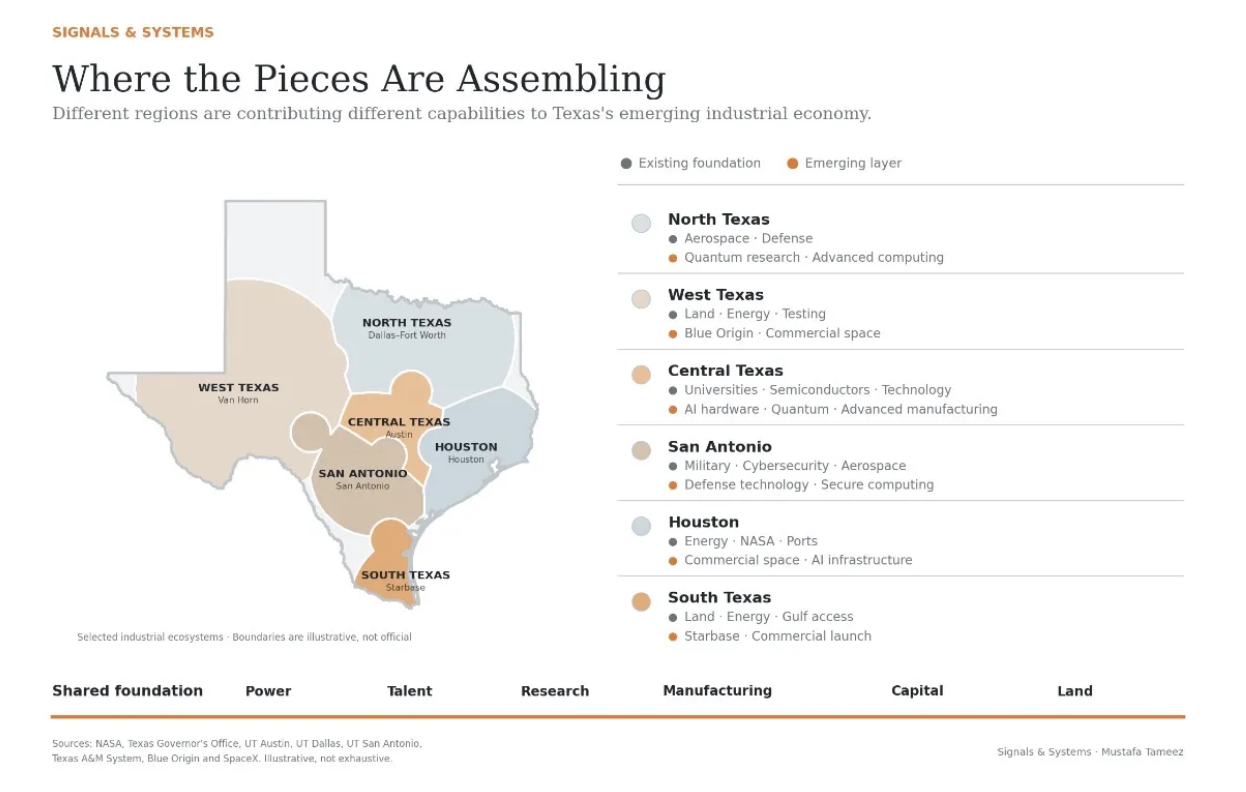
I had been writing about artificial intelligence and the physical systems required to support it. When I began looking at quantum computing and Goldman Sachs’ report on what it calls the “Second Space Age,” I found many of the same requirements: land, power, laboratories, factories, and people whose knowledge is difficult to replace.
Goldman describes a space economy being reshaped by reusable rockets, smaller satellites, private capital, computing, and advanced manufacturing.
Goldman was not writing about Texas. But launch operations, aerospace manufacturing, and generations of human spaceflight expertise are already here.
Maybe I had been thinking about Texas too narrowly.
I had been asking which industries were coming to Texas. I had not spent enough time asking who was coming with them.
Behind every corporate announcement is a personal decision. An engineer accepts a position. A researcher joins a Texas university. A technician moves a family. A student arrives for an education and decides whether to remain after graduation.
Industries do not move by themselves. People move, carrying knowledge, relationships, capital, and ambition with them.
Artificial intelligence, quantum computing, semiconductors, energy, and commercial space look like separate stories. But they depend on many of the same physical systems and many of the same people.
The question is whether those pieces begin to connect. Does university research reach manufacturers? Do graduates stay close enough to turn ideas into companies? Do institutions in different parts of Texas begin working across their boundaries?
If those connections deepen, Texas will have more than a collection of successful industries. It will have the beginnings of a system.
And Texas has rarely built only for itself.
Energy produced and refined here has powered economies far beyond the state. Goods moving through Texas ports reach markets around the world. Medical discoveries made in Houston improve the lives of people who will never visit Houston.
The same may become true of the data centers, chips, laboratories, rockets, and manufacturing plants taking shape here. They may become part of the physical foundation for technologies used around the world.
But scale does not guarantee success. Growth will place new demands on the Texas electrical grid, land, and water. Communities will also decide whether the jobs and investment are worth what these projects require of them.
Texas has the scale to build for the world. It still has to prove that it can build responsibly.
We have spent a great deal of time asking what Texas is becoming.
Maybe the answer begins with who is becoming a Texan.
People come from across the country and around the world. They arrive for work, education, family, safety, space, and possibility. Some stay long enough to build businesses, institutions, communities, and lives whose influence reaches far beyond them.
I was not born in Texas. Neither were millions of other Texans.
Some people stay without ever feeling rooted. Others leave after building something that lasts.
Perhaps being a Texan has less to do with where your life began than with what you decide to build and whether you stay long enough to see it matter.
People come from the world to become Texans.
What they build here goes back out to the world.
Frequently Asked Questions
What percentage of Texas adults were born in Texas?
The article cites 2022 data showing that about 51 percent of adults living in Texas were born in the state. Roughly 27 percent were born elsewhere in the United States and nearly 23 percent were born in another country.
Why is Texas attractive to people moving from other places?
The article describes Texas as a destination for people seeking work, education, family, safety, space and opportunity. It argues that people moving to Texas also bring knowledge, relationships, capital and ambition that can contribute to the state’s institutions and industries.
Do people who are born in Texas tend to stay there?
Yes. The article cites 2021 research showing that more than 82 percent of people born in Texas still lived in the state, making Texas notable both for retaining native-born residents and attracting newcomers.
How does the Port of Houston affect the Texas economy?
The article uses the Port of Houston as an example of how infrastructure located in one place can generate economic activity across a much larger region. Port activity connects with refineries, manufacturing, rail, warehousing, trucking, agriculture, stores and communities throughout Texas.
How does Texas Southern University contribute to the regional economy?
The article cites an analysis estimating Texas Southern University’s annual regional economic impact at approximately $1.6 billion, with more than 80 percent of that impact attributed to alumni. It argues that graduates continue producing economic value as they become professionals, business owners, researchers, educators and public servants.
What industries could shape the next stage of Texas economic growth?
The article identifies artificial intelligence, quantum computing, semiconductors, energy and commercial space as potentially interconnected parts of Texas’s future economy. These industries share requirements such as power, land, laboratories, manufacturing capabilities and specialized talent.
What does Texas need to do to turn individual industries into a broader innovation ecosystem?
The article argues that stronger connections are essential: university research must reach manufacturers, graduates must remain close enough to turn ideas into companies, and institutions across different parts of Texas must collaborate. It also cautions that growth must be managed responsibly because large-scale development will increase demands on electricity, land and water.
Sources and Further Reading
- Federal Reserve Bank of Dallas — Texas Natives Likeliest to “Stick” Around
Uses American Community Survey data to examine interstate retention and reports that approximately 82 percent of people born in Texas still lived in the state in 2021.
Federal Reserve Bank of Dallas analysis - Houston Chronicle — Where Were Most Adults in Texas Actually Born?
Analyzes Census data showing that about 51 percent of Texas adults in 2022 were born in the state and examines the growing role of domestic and international migration.
Houston Chronicle demographic analysis - D.C. Policy Center — Made in D.C.: Which Areas Have the Highest Share of D.C.-Born Residents?
Uses Census and American Community Survey data to examine how many Washington residents were born in the District and the city’s longstanding role as a destination for newcomers.
D.C. Policy Center analysis - Port Houston — Port of Houston Activity Supports Nearly $1 Trillion in U.S. Economic Value
Highlights updated research on the Houston Ship Channel’s extensive economic reach and its connections to employment, trade and industries beyond the immediate port area.
Port Houston economic impact information - Texas Southern University — Economic Impact Report
Reports that Texas Southern University generates approximately $1.6 billion in annual regional economic impact and emphasizes the contribution of its graduates and alumni.
Texas Southern University economic impact news - Goldman Sachs — The Second Space Age: How Markets, Technology, and Power Are Reshaping the Final Frontier
Explores how reusable launch systems, smaller satellites, private investment, computing and advanced manufacturing are reshaping the commercial space economy.
Goldman Sachs Second Space Age report - Office of the Texas Governor — Texas Semiconductor Innovation Consortium
Describes Texas’s statewide effort to connect higher education, industry and workforce development around semiconductor research, design and manufacturing.
Texas Semiconductor Innovation Consortium - Office of the Texas Governor — Quantum Initiative Advisory Committee
Explains the state’s formal initiative to develop a strategic plan for promoting Texas’s quantum economy, providing additional context for the article’s discussion of emerging technology ecosystems.
Texas Quantum Initiative announcement
