
Summary
The article examines how Texas is evolving from an economy historically defined by oil and gas into one increasingly shaped by technology, artificial intelligence, advanced manufacturing, and digital infrastructure. Through personal reflection, economic analysis, and corporate trends, the author argues that identity influences investment, policy, workforce development, and long-term competitiveness. The piece suggests that Texas’s greatest opportunity lies in leveraging its energy foundation to become the infrastructure hub of the AI era.
What Do We Call Texas Now?
By Mustafa Tameez
JUL 28, 2026
When I started my business in 2004, I struggled with the same question many founders face: What do you call it? The work was still taking shape, but the name felt permanent. I worried over the logo, the business cards and whether the words I chose would still describe the company years later.
I settled on Outreach Strategists.
That same year, Texas crossed an important demographic threshold and became what demographers call a majority-minority state. We began, in part, by helping institutions understand and reach Texas’s growing Asian American population. Over time, however, outreach came to mean something larger than ethnicity, translation or placing a message in the right publication. It meant understanding how people see themselves, how institutions see them and what happens when those two views do not line up.
That question had been part of my life long before it became part of my work.
My family moved to Astoria, Queens, in 1978. When my parents enrolled me in an American school for the first time, they had to check a box marked “Asian American.” I doubt they had ever used that term to describe us. We knew where we came from. We knew our family, our culture and our history. Then an American institution gave us another category, and over time it became part of how we understood ourselves.
Identity is partly claimed and partly assigned.
Mine changed again after I moved to Houston in 1994. For several years, I still thought of myself as a New Yorker who happened to live in Texas. Then, on a flight, someone asked me where home was.
Without thinking, I said, “Houston.”
That was when I knew I had become a Texan.
How Long Does It Take to Become Something New?
One of the first things that astonished people about ChatGPT was its speed. It could take longer to type a one-line question than for the system to produce a page-long answer. That speed made me realize that AI was beginning to automate not just tasks, but parts of the process by which work itself gets produced. It also made me wonder about something technology cannot compress so easily: How long does it take for an identity to change?
A machine can generate an answer in seconds. People can change before they have the language to describe who they have become. Places can, too. Sometimes the underlying reality moves first. Recognition comes later.
Texas may be living through that kind of lag.
Identity matters because it influences behavior. In our work at Outreach Strategists, creating change often begins with changing behavior. But you cannot move people until you understand where they are starting from. That requires standing in someone else’s shoes and seeing the world as they see it, not merely as a business, campaign or government agency sees them.
The same principle applies to institutions and places. A company that misunderstands what it has become may continue serving yesterday’s market. A government agency may cling to an outdated understanding of its mission. A state can keep acting from an identity that once fit but no longer describes the economy developing underneath it.
For much of the country, I suspect Texas still means oil. It means drilling rigs, pipelines and refineries. It means ExxonMobil and the great energy companies that helped create the state’s wealth, infrastructure and influence. America still sees much of Texas through the oil field and the ranch, an image television has reinforced from J.R. Ewing in Dallas to the roughneck world of Landman on Paramount+. The characters have changed, but the image has proved remarkably durable.
That picture was never entirely wrong. But it no longer tells the whole story.
Another Texas is emerging behind that image: a state building the physical systems on which artificial intelligence will depend.
I Thought Houston Would Change the Picture
My friend Stephen Klineberg, the Rice University sociologist who helped found what became the Kinder Institute for Urban Research, taught me years ago to think about Houston’s growth as more than a population story.
He believed Houston was on a path to overtake Chicago and become the country’s third-largest city. I always thought that would change more than a ranking.
Dallas had supplied one national shorthand. Houston could supply another: international, immigrant, diverse, and connected to energy, medicine, space, and global trade. I imagined that when Houston eventually passed Chicago, people outside Texas would see more of the state we know, a place more varied and globally connected than the image they had inherited from television.
I assumed population growth would change the picture of Texas.
Now I wonder whether the corporate world got there first.
A Change Hidden in Plain Sight
During the pandemic, most of us were focused on illness, shutdowns, schools, vaccines and survival. Meanwhile, Oracle made Austin its headquarters. Hewlett Packard Enterprise moved its corporate headquarters to the Houston area. Tesla relocated its corporate headquarters to Austin. Each announcement received attention, but the larger pattern was easier to miss.
These were not simply real-estate decisions or another round in the rivalry between Texas and California. Some of the world’s most valuable technology companies were making Texas part of their formal identity. They joined companies Texas had already created, including Texas Instruments and Dell.
That made me think about corporate identity in a different way. I began to think that a state’s corporate identity is shaped, at least in part, by the companies that choose to build their futures there.
We also could not yet see how quickly artificial intelligence would increase the importance of those decisions. Chips, servers, software, data centers, electricity and technical talent were becoming the infrastructure of the next economy.
The public story still centered on oil. The corporate world was beginning to picture something else.
At the same time, Texas itself was moving into a different economic class. Preliminary estimates put the state’s 2025 economic output at roughly $2.9 trillion. Compared with the nations of the world, that would rank Texas around eighth, up from the ninth-place comparison commonly used only a few years earlier. Texas was not merely becoming larger. The companies increasingly shaping its future were changing too.
What the Numbers Began to Show
I wanted to know whether this change was real or whether I was simply seeing what I wanted to see. So I looked at the Texas-headquartered companies on the 2025 Fortune 500 and divided them into two groups: technology and artificial intelligence, and oil-and-gas producers and refiners.
The result surprised me.
Market value does not measure the entire Texas economy, but it does reveal where investors believe the future is being built.

Methodology: Technology and AI includes Texas-headquartered companies on the 2025 Fortune 500 in Fortune’s computers, computer software and semiconductor categories, with Tesla included as a technology and AI company. Oil and gas includes Texas-headquartered Fortune 500 petroleum refiners and oil-and-gas producers. The same company group is used throughout the 2021–2025 comparison; Chevron is included across the full period for consistency. Values are approximate year-end market capitalizations. Sources: Fortune 500 (2025) and CompaniesMarketCap historical data.
The lines do not move neatly. Technology and AI were already ahead in 2021, largely because Tesla had reached an extraordinary valuation. Oil and gas surged back ahead in 2022 as technology stocks fell and energy companies benefited from an exceptional year. Then, beginning in 2023, technology moved back in front and began to separate. By the end of 2025, the technology and AI companies were worth about $2.43 trillion, just over twice the $1.18 trillion value of the oil-and-gas producers and refiners.
The market had already begun calling Texas something different.
Much of that lead comes from Tesla. At first, I thought that complicated the comparison. Then I began to think it might be the most important part of it.
Tesla became one of the world’s most valuable companies in part because it has never presented itself as simply a traditional car company. It has defined itself through software, artificial intelligence, autonomy, robotics and energy. That identity has shaped the talent it recruits, the products it pursues, the risks it accepts, and the future investors believe it can build.
Texas now faces a similar question. Is it an oil state that happens to attract technology companies, or is it becoming the place where energy, computing, advanced manufacturing, space and artificial intelligence come together?
How Texas answers that question will shape more than its image.
How Texas sees itself will influence what it funds, what it builds, and how it prepares people for the future. If Texas continues to see itself primarily as an oil-and-gas state, it will protect one version of its economy. If it sees itself as the infrastructure state for the AI age, it will make different choices about power, research, universities and semiconductors.
Market value is not the only indication of scale. Dell and Texas Instruments alone employ more than 130,000 people worldwide. That does not mean technology employs more Texans than oil and gas, whose contractor and supplier network is enormous. It does show that the technology companies born here have become major operating institutions in their own right.
The Economy Texas Built – and the One It Is Building
The older and newer identities of Texas do not really compete. The AI economy is drawing power from the energy economy that built the state, literally and economically. Data centers, semiconductor plants and advanced manufacturing require reliable electricity, land, water, engineering, construction, capital and a willingness to build at scale.
Texas also has something few states can claim in quite the same way: its own largely separate electric grid. ERCOT manages about 90 percent of the state’s electric load. That independence has exposed serious vulnerabilities, as Texans know, but it also places unusual responsibility on the state as electricity demand rises.
That opportunity is not guaranteed. ERCOT is preparing for demand growth on a scale Texas has never seen, much of it driven by large users such as data centers. Water and workforce capacity will also determine how much of this opportunity Texas can capture. The question is not whether Texas has the assets. It is whether it can expand them fast enough.
Texas has already shown how energy innovation can change the country. Advances in horizontal drilling, hydraulic fracturing, data and engineering helped unlock American oil and natural gas production and move the United States toward greater energy security. Texas was central to that transformation.
Texas may not invent every frontier AI model. It is positioned to do something equally consequential: build, power, cool and scale the physical infrastructure those models require.
Silicon Valley may write much of the code. Texas may build the system that allows it to run.
There is a reason the physical infrastructure behind the AI economy is finding its way here. If AI could click its heels three times and choose a home, there may be no place like Texas.
The state’s old identity is not an obstacle to its new one. It is part of the reason the new identity is possible.
But infrastructure alone will not be enough. Texas will also need workers prepared for the economy being built around them.
This is what identity looks like when it begins to shape institutions.
In our work with Houston City College, I have seen a tangible example of what preparation can look like. For decades, it was Houston Community College. In 2025, it became Houston City College. It now serves more than 100,000 enrolled students and offers programs beyond the conventional image of a two-year college, including a four-year Bachelor of Applied Technology in Artificial Intelligence and Robotics.
The word “community” was not wrong. The college remains deeply rooted in the community. But the old name no longer fully described its scale, its ambitions or the role it intends to play in Houston’s future.
Houston City College is not waiting for the economy to announce what it has become. It is training people for the economy already arriving.
The same identity challenge will reach people, companies and public institutions. Employers will need workers who understand both the skilled trades and the technology increasingly shaping those jobs. Educators will have to prepare students for work that may change repeatedly throughout their careers. Policymakers will have to connect investments in power and technical education with the needs of communities and industries across the state. All of them will have to make decisions based on the Texas that is emerging, not just the Texas they remember.
I started with a simple question: What do we call Texas now? The answer is not that oil has disappeared. It is that Texas built an energy economy so large and capable that it may now become the foundation of something new.
I know from my own life that identity often changes before the words do. Houston became home before I knew to call it that. Texas may be in a similar moment. The companies and capital have already moved, and the infrastructure is taking shape. What remains is whether the state sees clearly enough what it is becoming to make the choices that come next.
The market may have already answered the question. The rest of us now have to decide whether we will keep building for the Texas we remember or build deliberately for the Texas we are becoming.
Appendix: The Companies Behind the Graph
The graph compares the year-end market value of the following Texas-headquartered Fortune 500 companies. The same company groups are used throughout the 2021–2025 period.
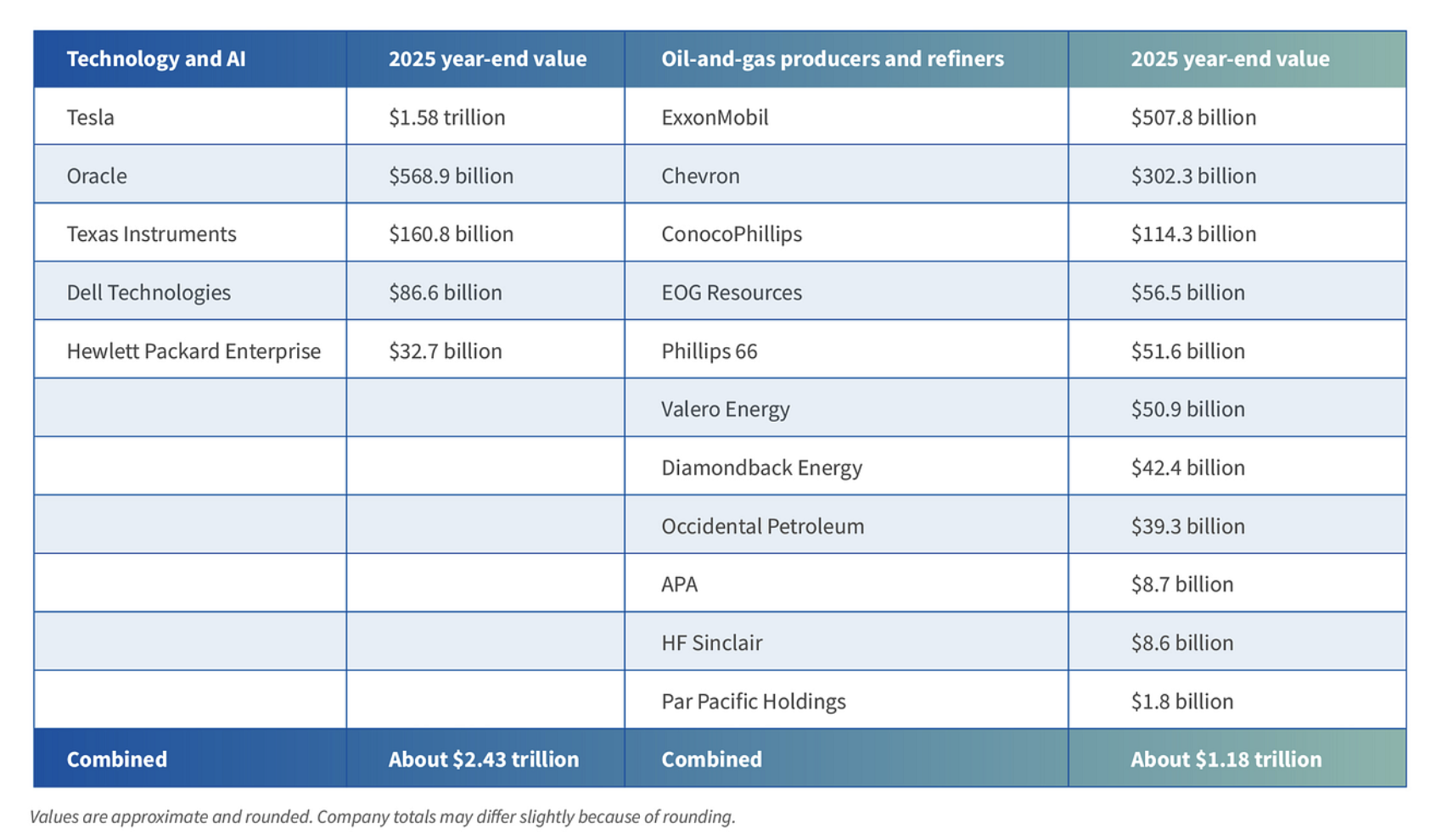
Tesla is included as a technology and AI company because its strategy and valuation extend beyond traditional automobile manufacturing into software, artificial intelligence, autonomy, robotics and energy. Chevron is included throughout the historical comparison to maintain a consistent company group, although it moved its headquarters to Houston during the period analyzed.
Frequently Asked Questions
Why is Texas becoming important to the artificial intelligence economy?
Texas offers many of the physical assets required to support AI, including abundant energy resources, engineering talent, available land, and advanced manufacturing. As demand for data centers and computing infrastructure grows, organizations such as the Semiconductor Industry Association and Stanford Institute for Human-Centered Artificial Intelligence have highlighted the increasing importance of infrastructure in supporting AI innovation.
How does artificial intelligence depend on energy infrastructure?
Artificial intelligence requires significant computing power, and computing depends on reliable electricity, cooling systems, and modern data centers. The U.S. Energy Information Administration and Electric Reliability Council of Texas provide data showing how electricity demand is becoming an increasingly important consideration as AI infrastructure expands.
Why are technology companies relocating to Texas?
Companies evaluate locations based on workforce availability, infrastructure, business climate, and long-term growth opportunities. The article highlights Texas’s growing role as a technology hub, while the Texas Economic Development & Tourism Office tracks continued business investment and industry expansion across the state.
What role does workforce development play in the AI economy?
As AI transforms industries, employers need workers with both technical expertise and adaptable skills. Educational institutions and workforce organizations are expanding programs to prepare students for emerging careers, while the Stanford Institute for Human-Centered Artificial Intelligence has reported that AI adoption is increasing demand for new skills across many sectors.
Why does economic identity matter for states?
A state’s identity influences investment, public policy, education, and economic development decisions. Understanding how industries evolve helps governments, businesses, and educational institutions make informed long-term choices, as reflected in research published by the Texas Economic Development & Tourism Office and national business analyses such as the Fortune 500.
How are energy and artificial intelligence connected?
Energy and AI increasingly support one another. AI requires reliable electricity and infrastructure, while digital technologies can improve energy production and operations. Research from the U.S. Energy Information Administration and the Semiconductor Industry Association illustrates how energy, computing, and semiconductor manufacturing are becoming more closely linked.
What industries are driving Texas's future economy?
The article suggests Texas’s future will be shaped by the convergence of energy, artificial intelligence, advanced manufacturing, semiconductors, healthcare, logistics, and higher education. Data from the Fortune 500 and CompaniesMarketCap demonstrate how technology companies have become an increasingly significant part of Texas’s corporate landscape.
Sources and Further Reading
- Fortune 500
Provides annual rankings and industry classifications for major U.S. companies, including Texas-headquartered corporations referenced in the article.
https://fortune.com/ranking/fortune500/ - CompaniesMarketCap
Tracks historical market capitalizations used to compare technology and energy companies over time.
https://companiesmarketcap.com/ - ERCOT (Electric Reliability Council of Texas)
Official information on Texas’s electric grid, electricity demand, planning, and infrastructure.
https://www.ercot.com/ - Texas Economic Development & Tourism Office
Official resource on Texas industries, business recruitment, workforce, and economic development initiatives.
https://gov.texas.gov/business - U.S. Energy Information Administration (EIA)
Provides authoritative data on U.S. energy production, electricity demand, oil, natural gas, and infrastructure.
https://www.eia.gov/ - Semiconductor Industry Association
Research and information about semiconductor manufacturing, supply chains, and the industry’s role in the digital economy.
https://www.semiconductors.org/ - Stanford Institute for Human-Centered Artificial Intelligence (HAI) – AI Index Report
Annual report covering AI investment, infrastructure, workforce, and global technology trends.
https://hai.stanford.edu/ai-index - Houston City College
Information on academic programs, workforce education, and the institution’s expansion into artificial intelligence and robotics.
https://www.hccs.edu/
VP’s Take
Dr. Michelle Cantú-Wilson, Vice President of Education & Workforce, Outreach Strategists:
“Economic transformation is ultimately a talent story. As industries evolve, educational institutions and employers have an opportunity to prepare learners with the technical skills, adaptability, and lifelong learning mindset needed to thrive in emerging careers. States that align workforce development with future industry needs will be better positioned to sustain innovation and economic growth.”
