
Summary
This article argues that the future of artificial intelligence adoption may depend less on technical capability and more on whether people believe its environmental and societal costs are justified. Drawing on personal experiences, conversations with environmental advocates and colleagues, and research on technology adoption, the author explores how concerns about energy use, water consumption, and fairness could slow AI adoption among the broader public. The essay concludes that AI companies will need to earn trust through transparency, efficiency, and shared public benefits rather than relying on technological innovation alone.
The Signal I Missed
By Mustafa Tameez
AUG 11, 2026
My brother canceled his Fourth of July gathering in New Jersey this year because the weather made an outdoor event impractical. We grew up together in a one-bedroom apartment in Astoria, Queens, and today he lives in a beautiful farmhouse with his own private pond. Yet hearing about the cancellation took me back not to the farmhouse, but to the window air conditioner that once cooled our apartment.
That air conditioner was part appliance and part family argument. My father hated the electric bill and frequently reminded us how expensive the unit was and how much money we were wasting. He would suggest taking it out so we could open the entire window and let in the summer air. We did not buy the argument, but we did learn to turn the air conditioner off before he got home.
The unit was loud, leaked water, blocked most of the window and cooled only part of a small apartment. Still, when New York became hot and humid, we wanted it running. My father saw the cost more clearly than we did; we felt the benefit more immediately than he did.
When I moved to Houston in 1994, I appreciated almost immediately that nearly everything was centrally air-conditioned. Homes, offices, stores, restaurants and cars all offered an escape from the heat. During my first Christmas here, I saw people blasting the air conditioner while running the fireplace for ambience, and I thought I had arrived.
I still believe that, other than the Port of Houston, few technologies were more important to the development of modern Houston than central air conditioning. It did more than make the city comfortable. It allowed millions of people to live, work and build companies in a climate that might otherwise have constrained Houston’s growth. There is something fitting about the Astros now playing at Daikin Park, named for one of the world’s largest air-conditioning companies.
Air conditioning helped make Houston possible, and it also required enormous amounts of electricity. Those facts do not cancel each other out. People may accept the use of significant shared resources when they believe they will share in the benefits. They are more likely to resist when the costs are public and the rewards appear private.
That may be the question artificial intelligence now has to answer.Something Said Off the Air
Once a month, I participate in one of my favorite programs on Houston Public Media, The Good, the Bad and the Ugly, where I sit on a panel with some of Houston’s most interesting people. We are introduced as nonexperts, a description that has always felt comfortable to me. Being a nonexpert gives you permission to listen, ask questions and admit when someone else may have seen something you missed.
Earlier this month, one of my fellow panelists was Jennifer Hadayia, the executive director of Air Alliance Houston. We discussed artificial intelligence on the air, but it was something Jennifer said afterward that stayed with me. I am paraphrasing, but her point was simple: She understood how useful AI could be, yet she chose not to use it because she did not like its environmental impact.
I am an enthusiastic early adopter of AI and have reorganized much of how I work around what it makes possible: better research, faster analysis, new ways to communicate and the automation of repetitive tasks. Her comment made me wonder how many others were making a similar choice—not because they failed to see AI’s value, but because they understood the bargain and found it unfair.
A 2025 AP-NORC survey found that 72 percent of Americans were at least somewhat concerned about AI’s environmental consequences, including 41 percent who were very or extremely concerned. That surprised me because we usually assume new technologies move from the young to the old. Young people adopt them first, and parents, employers and institutions eventually catch up.
AI may be complicating that pattern. In an earlier essay, I wrote about graduation speakers being booed when they mentioned artificial intelligence. Young people worry about entry-level jobs disappearing, artists and writers worry that their work is being taken without permission, and students are preparing for a world in which AI can already perform some of the work they are training to do.
What I may have underestimated was the environmental part of that resistance. For many younger people, climate change influences how they think about food, transportation, clothing, investments and the companies they support. When they hear that AI depends on data centers drawing heavily on electricity, water and local infrastructure, some see a reason not to participate.
One of my staff members helped me understand another side of the concern. She has invested considerable time learning how to use AI, developing agents for repetitive tasks and deciding what should be automated and what still requires human judgment. Recently, she told me about smaller models that can run directly on a laptop rather than sending every request to a distant data center. As she spoke, I sensed a trace of guilt about how much she had been using AI.
That caught my attention because she had experienced the benefits firsthand. AI helped her work faster and imagine new ways of doing her job, yet the more she learned about the technology, the more conscious she became of the resources behind every seemingly effortless request.
Environmental concern, I realized, is not limited to people who reject AI. Jennifer understands its value and chooses not to use it. My staff member uses it deeply but feels conflicted. I use it enthusiastically and had not fully appreciated the concern.
People can make a technology part of their lives without feeling entirely comfortable with the system behind it.
I Was Watching the Wrong Signal
In an earlier essay, I explored why AI adoption appeared to be moving at different speeds around the world. I suggested that people in emerging economies might adopt it more quickly because they had fewer legacy systems, fewer established habits and more to gain from a technology that could lower barriers to education, expertise and opportunity.
An OECD survey offers some support for that idea. It found especially strong generative-AI use among people ages 18 to 35 in India, Brazil and South Africa, while Germany, France and Italy showed lower uptake. Younger respondents in emerging economies also expressed greater optimism about the technology.
Access and opportunity are clearly part of the story, but Jennifer’s comment made me wonder what else I had missed. Some people may be hesitating because they are asking questions early adopters like me were quicker to set aside: What happens to jobs? Who owns the work used to train these systems? Can the answers be trusted? How much electricity and water does AI consume? Who benefits, and who carries the cost?
The evidence does not establish that environmental concern explains global differences in adoption. Income, education, workplace practices and government policy also matter. Jennifer’s comment nevertheless made me realize that I had focused mostly on access and capability, while paying less attention to whether people believed the bargain was fair.
What the Early Majority Will Ask
The technology-adoption curve begins with innovators, followed by early adopters, the early majority, the late majority and those who resist until a technology becomes nearly unavoidable. Trying an AI chatbot once is not the same as trusting it enough to make it part of your work or life.
Innovators make up the first 2.5 percent of the curve, and by temperament I probably belong in that group when it comes to AI. We tolerate imperfections because the possibilities are exciting enough. Our first question is whether the technology can work. Early adopters then ask whether it can give them an advantage.
The early majority is less interested in being first. They want to know whether it is dependable, worth the cost and easy to fit into daily life. They also want to know whether they can trust the companies behind it and whether using it is consistent with their values.
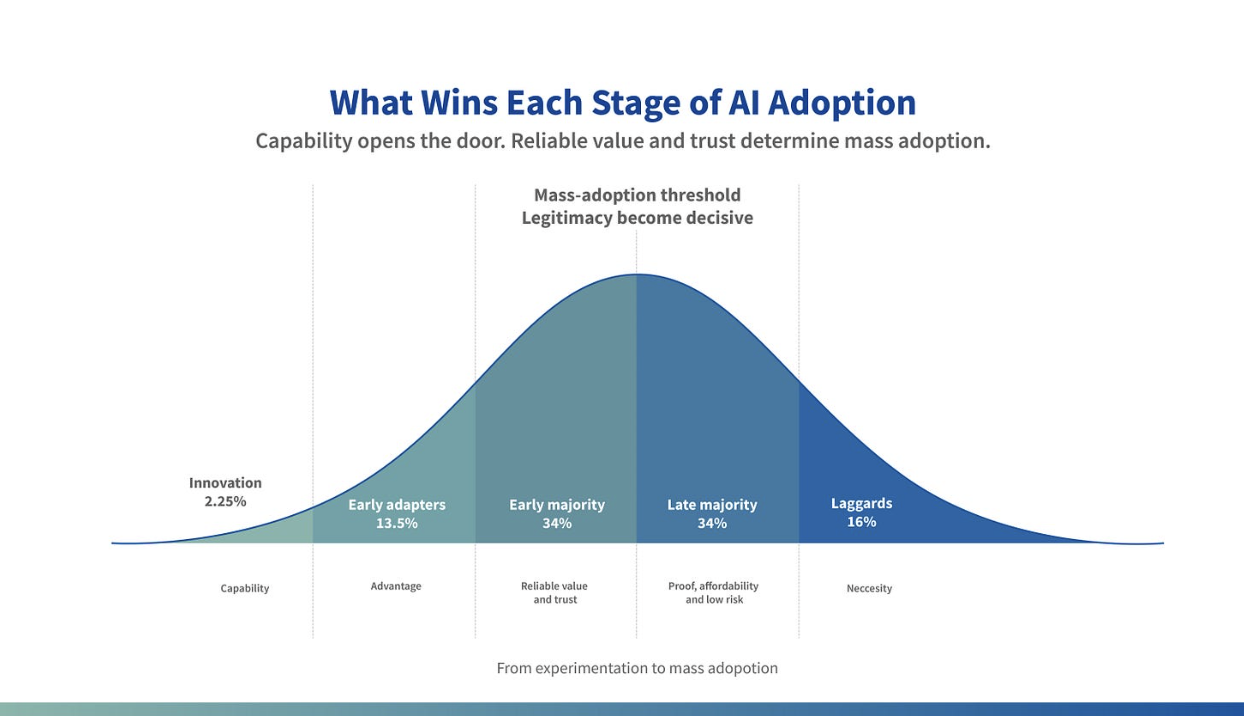
Generative AI captured public attention quickly because it arrived through devices people already owned, was easy to try and could produce an astonishing result during a first interaction. Yet it is attempting to compress into a few years what most technologies took decades to accomplish. It is improving at machine speed while moving through an adoption curve governed by human confidence.
That creates the gap at the center of this essay: AI has developed intelligence faster than it has earned legitimacy. To reach the early majority, it must show that the shared resources it consumes produce benefits people can see, trust and broadly share.
Trust Cannot Be Manufactured
In my business, people often think messaging is about finding the perfect frame or arranging words that will make an audience feel better. But people do not trust an organization because it has learned to sound responsible. They trust it when its actions demonstrate responsibility.
People like me can help an organization explain what it is doing, but we cannot substitute for doing it. The AI industry cannot answer environmental concerns only with better talking points about innovation, efficiency and economic development. It has to put its house in order.
That means greater transparency about resource use, investment in cleaner power and better cooling, and models that accomplish more with less. It also means showing that the benefits extend beyond the companies building the technology.
This debate is no longer theoretical. Across the country, communities are moving from asking whether data centers are coming to deciding what they should require before approving them.
When communities are asked to provide land, grid capacity, water and public infrastructure for data centers, they will want to know what they receive in return. Do the projects create meaningful jobs? Do they strengthen the electric grid or strain it? Will schools, hospitals and small businesses gain tools that improve their work, or will the public carry the cost while the largest rewards flow somewhere else?
The message becomes credible only when the system behind it is credible.
The Race to Use Less
Companies are investing extraordinary amounts in data centers, chips, power generation and transmission. The International Energy Agency estimates that data centers consumed about 415 terawatt-hours of electricity worldwide in 2024, roughly 1.5 percent of global consumption, and projects that demand could more than double by 2030, with AI as a major driver.
Not every company making these investments will win. Some may build infrastructure they never fully use, while others may discover that smaller models, better software or localized computing can perform tasks that once appeared to require massive centralized systems.
AI also has an unusual characteristic: People can use it to improve the systems that power AI itself. It can help write code, optimize software and identify ways to accomplish the same task with fewer resources. I have often described this as the automation of automation.
Economic and environmental pressure may therefore begin to reinforce each other. Less electricity means lower operating costs. Smaller models are easier to deploy. More efficient systems require fewer chips and less infrastructure, while companies that can document lower water and power consumption may face less community opposition.
Environmental responsibility may not simply be an obligation; it may become a competitive advantage. Ironically, the same market forces driving companies to build ever-larger data centers may ultimately reward those that need fewer of them. The race may not simply be to build the biggest model, but to build the one that delivers the same intelligence with a fraction of the electricity.
Bak at the Window
My father was not wrong about our air conditioner. It was expensive, it leaked, it blocked the window and it probably consumed more electricity than it needed to. We were not wrong either, because on the hottest days the benefit was undeniable.
As a child, I thought my father was simply worried about the electric bill. Looking back, I understand that he was asking a larger question: Was the comfort worth what it cost our family?
Air conditioning did not become acceptable because its costs disappeared. It became indispensable as its benefits spread and its efficiency improved. Houston stopped treating it as an occasional luxury because it made homes livable, businesses productive and the growth of an entire city possible.
AI cannot assume the same outcome. It is moving too quickly, consuming too much capital and asking too much of shared infrastructure to expect the early majority simply to follow the enthusiasts. It must show not only that it can do remarkable things, but that the resources behind those remarkable things produce benefits people can see and share.
The companies that win may not simply build the most powerful intelligence. They may build the intelligence society believes is worth the cost.
Frequently Asked Questions
Why does the author believe environmental concerns matter for AI adoption?
The author argues that many people recognize AI’s benefits but are increasingly concerned about its electricity use, water consumption, and infrastructure demands. These concerns may influence whether people choose to incorporate AI into their daily lives and work.
How does air conditioning relate to artificial intelligence in the article?
The essay uses air conditioning as a historical analogy to show that transformative technologies gain widespread acceptance when their benefits clearly outweigh their costs. The author suggests AI must similarly demonstrate that its societal value justifies its resource consumption.
What concerns do people have about AI beyond environmental issues?
According to the article, people also question AI’s effects on jobs, ownership of creative work, the reliability of AI-generated information, and who ultimately benefits from the technology. These issues contribute to broader questions of fairness and trust.
What is the "early majority" in technology adoption?
The article explains that the early majority represents users who adopt new technologies only after they believe those technologies are dependable, trustworthy, practical, and aligned with their values. They differ from innovators and early adopters, who are generally more willing to accept uncertainty.
Why are data centers important to the discussion about AI?
Data centers provide the computing infrastructure that powers modern AI systems but require substantial electricity and other shared resources. The article argues that communities will increasingly ask whether these investments create sufficient public benefits.
How can AI companies build public trust?
The author contends that companies must demonstrate responsible behavior through transparency, more efficient technologies, cleaner energy investments, and broader public benefits rather than relying solely on persuasive messaging.
What does the author identify as the biggest challenge facing AI?
The article concludes that AI has advanced technologically faster than it has earned public legitimacy. Long-term success will depend on convincing the broader public that its benefits are widely shared and worth the resources required to produce them.
Sources and Further Reading
- International Energy Agency (IEA)
Provides global analysis of energy demand, including projections for electricity use by AI and data centers.
https://www.iea.org/reports/energy-and-ai - AP-NORC Center for Public Affairs Research
Conducts public opinion surveys, including research on Americans’ attitudes toward artificial intelligence.
https://apnorc.org/ - Organisation for Economic Co-operation and Development (OECD)
Publishes international research on AI adoption, workforce trends, and public policy.
https://www.oecd.org/en/topics/artificial-intelligence.html - National Institute of Standards and Technology (NIST)
Develops frameworks and guidance for trustworthy and responsible AI systems.
https://www.nist.gov/itl/ai-risk-management-framework - U.S. Department of Energy
Provides information on electricity infrastructure, energy efficiency, and emerging technologies affecting power demand.
https://www.energy.gov/ - World Resources Institute (WRI)
Researches sustainable infrastructure, climate policy, water resources, and energy systems relevant to AI development.
https://www.wri.org/ - Electric Power Research Institute (EPRI)
Studies electricity demand, grid modernization, and the implications of emerging technologies, including AI.
https://www.epri.com/ - Stanford Institute for Human-Centered Artificial Intelligence (HAI)
Publishes research on AI policy, governance, public trust, and societal impacts.
https://hai.stanford.edu/
VP’s Take
Sabiha Gire, Vice President of Client Services, Outreach Strategists:
“Every transformative technology eventually faces a trust test. Organizations that acknowledge legitimate public concerns, communicate transparently, and demonstrate measurable responsibility will be better positioned to earn lasting confidence than those that rely solely on the promise of innovation.”
