
Summary
Artificial intelligence and quantum computing are often portrayed as separate technological revolutions, but AI may help make practical quantum computing possible before quantum computers significantly enhance AI. The article explores how AI can assist with quantum error correction and system stability, creating the possibility of a feedback loop in which the technologies eventually accelerate each other’s development. It argues that Texas has an opportunity to connect its universities, semiconductor industry, energy sector, medical institutions, advanced manufacturing capabilities, and workforce development systems around this emerging convergence while preparing for its technological and security risks.
Come Together: When AI Meets Quantum Computing in Texas
By Mustafa Tameez
AUG 18, 2026
My eldest son is getting married next month. In typical South Asian fashion, what we call a wedding is really a series of celebrations stretching across two weeks, two states and more than 800 people.
Selma and I are deep into the planning, which means almost every conversation eventually circles back to the wedding. We may begin by talking about work, something happening in the world or what we are having for dinner. Before long, we are discussing a guest list, a ceremony, an outfit or a song.
Somewhere in the middle of all this, I remembered the title of the Beatles’ “Come Together.” I could not recall the lyrics or even the melody, so I played it again. Within seconds, the whole song came back to me.
I knew it would not work for the wedding. It is too strange and unsettled. But once I heard it again, I could not get it out of my head, perhaps because the title belonged to something else I had been thinking about: artificial intelligence and quantum computing.
They are usually described as separate technological revolutions. Artificial intelligence is already changing how we write, design, analyze, predict and discover. Quantum computing still feels distant, hidden inside research laboratories, universities and specialized companies.
Yet the more I read, the more I encountered an unexpected possibility. Most people assume quantum computing will eventually make artificial intelligence dramatically more powerful. Increasingly, it appears the opposite may happen first.
AI may help make practical quantum computing possible before quantum computing makes AI more powerful.
AI May Have to Help Quantum First
The easiest mistake to make about quantum computing is to think of it as a much faster version of the computer we already use. It is not.
Conventional computers process information through bits that register as either zero or one. Quantum computers use qubits, which behave according to the rules of quantum physics and can approach certain calculations differently from conventional machines.
That does not mean quantum computers will make email, spreadsheets or most ordinary software faster. Their potential lies in a narrower group of problems involving molecules, materials, optimization, cryptography and complex physical systems.
The future is also unlikely to involve quantum computers replacing today’s machines. A more realistic picture is a hybrid system. Conventional processors will continue doing most of the work. Artificial intelligence will help analyze information and guide decisions. Quantum processors may handle particular calculations suited to quantum methods.
Before that can happen at meaningful scale, quantum computers must become much more reliable.
Qubits are extraordinarily fragile. Small environmental changes, imperfect controls and accumulated errors can cause a calculation to fall apart. Researchers are learning how to protect quantum information by spreading it across groups of physical qubits, creating more dependable logical qubits. Even then, the systems require constant monitoring, correction and recalibration.
This is where artificial intelligence is already becoming useful.
Last month, in an experiment using Google’s Willow processor, researchers used a reinforcement-learning system to monitor error signals and adjust more than 1,000 control settings while the machine was operating. Rather than stopping the calculation every time the system drifted, the AI learned to recognize warning signs and make corrections along the way. A neural-network decoder also helped interpret the errors.
In ordinary language, the quantum computer was telling researchers where it was beginning to lose its balance. The AI listened and helped steady it.
That reverses the way most of us imagine the relationship. We picture quantum computing arriving first and suddenly making artificial intelligence vastly more powerful. The first important breakthrough may be more practical: AI may help stabilize quantum systems long enough for them to become useful.
That sounds less dramatic than science fiction. It may prove more important. Before a quantum machine can transform medicine, energy or materials research, it has to remain stable long enough to perform useful work. Artificial intelligence may help it get there.
An Acceleration of Acceleration
If quantum computers become reliable enough, they may eventually begin giving something back.
Researchers are exploring whether quantum processors could help with selected problems involving drug development, advanced materials, battery chemistry, energy systems, optimization and cryptography. Many of these applications remain prospective. Quantum computers have not yet demonstrated broad commercial superiority over the best conventional systems, and some of the most ambitious predictions may never materialize.
Still, the potential relationship is worth understanding.
Imagine that an AI system identifies a promising material from thousands of possibilities. A quantum processor models part of its behavior that is exceptionally difficult for a conventional computer to calculate. AI interprets the results and suggests what researchers should test next. Engineers use those findings to improve a battery, semiconductor, medicine or quantum device.
The improved technology then strengthens the next round of research. AI helps operate quantum systems. Quantum systems expand the range of selected problems researchers can investigate. AI interprets the results and helps guide what comes next.
None of this removes people from discovery. Scientists still have to ask worthwhile questions. Engineers must turn findings into functioning products. Institutions must decide what to finance, regulate and use.
What could change is the speed at which research, testing and improvement reinforce one another.
In a New Year message I wrote earlier, I called this an acceleration of acceleration. The tools producing progress begin improving one another. They do not simply move technology forward. They begin sharpening the tools that create the next generation of technology.
The first 25 years of this century gave us broadband, smartphones, social media, cloud computing and generative AI. The next 25 may prove more consequential because the technologies arriving now do not merely help us perform tasks. They increasingly help create the technologies that follow them.
The Intelligence Age begins when intelligent systems do more than process information or perform tasks, and start improving the tools that expand intelligence itself. AI helping make quantum computing practical may be one of the earliest and clearest signs that this transition is underway.
Quantum computing has seemed quieter because it has not yet had a ChatGPT moment. Much of its most important progress is taking place in error correction, logical qubits, calibration and control systems.
It has not disappeared because it failed. It has moved from spectacle to plumbing.
Public attention is focused on what AI can do today. The quieter signal is the computing architecture that may expand what AI can help us do tomorrow. In Texas, that could matter for semiconductors, batteries, energy systems and advanced manufacturing.
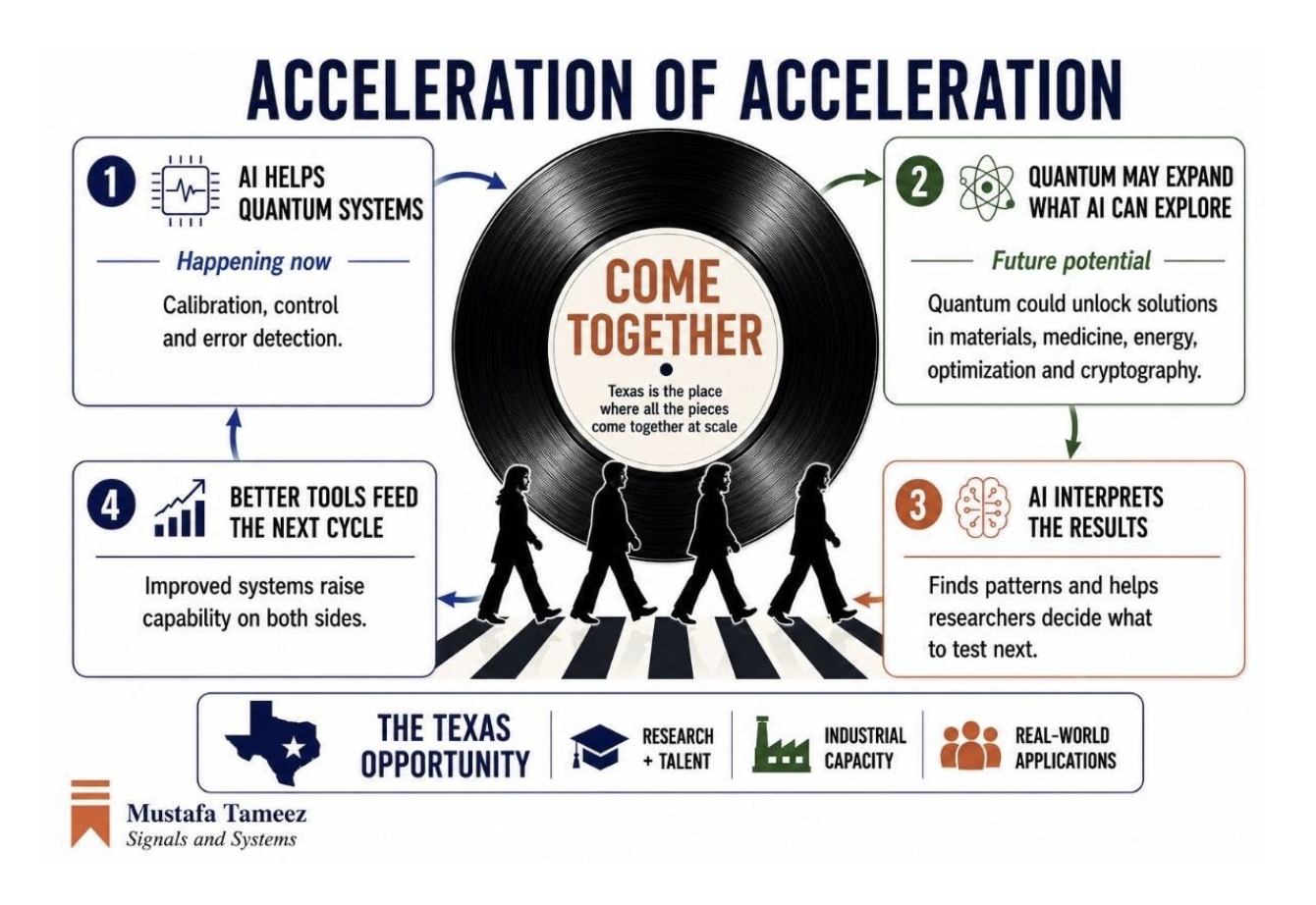 Figure 1. The AI–quantum feedback loop and the Texas opportunity.
The Texas Opportunity
As I thought more about this relationship between AI and quantum computing, I found myself asking a different question.
If these technologies really do begin improving one another, where will that happen?
Breakthroughs rarely change the world inside a laboratory. They matter when researchers, companies and investors begin turning discoveries into industries.
Texas is quietly assembling many of the pieces this convergence would require.
My work has long focused on how major changes move from ideas into institutions, infrastructure, workforces and public life. I will leave the physics to the physicists. My interest is what happens when the science begins reshaping Texas.
The Texas Quantum Initiative is beginning to connect research and industry. Just days ago, the Texas Quantum Summit at UT Dallas brought together leaders from academia, industry and government, while universities across the state expand their work in quantum science, semiconductors and artificial intelligence.
Texas also combines strengths in energy, medicine, semiconductors, software, advanced manufacturing and large-scale industrial production. Houston, Austin and North Texas each contribute different capabilities, giving the state an unusual range of assets.
None of that guarantees leadership. It simply creates the possibility.
Texas may not invent every element of the quantum future. Its opportunity is to become one of the places where quantum science, artificial intelligence and industrial scale meet.
A statewide quantum-AI consortium could link research universities, semiconductor manufacturers, Houston’s energy and medical institutions, and community colleges responsible for developing the future workforce.
Success will require patient investment and coordination that survives beyond a single legislative session or corporate announcement.
It will also require intellectual honesty.
Quantum computing remains early-stage. The full feedback loop between AI and quantum computing may take years or decades to mature. Some expected applications will disappoint. Others may arrive in forms no one currently anticipates.
Whether Texas becomes one of the places where this convergence takes hold remains an open question.
What We Choose to Build
The convergence of AI and quantum computing could help scientists develop medicines, discover materials and operate complex systems. It could also introduce new risks.
A powerful enough quantum computer could threaten forms of encryption that protect financial transactions, private communications and critical infrastructure. That danger is serious enough that institutions are already beginning to prepare for post-quantum security.
The larger concern is not only what these systems may eventually be able to calculate. It is whether their speed, complexity and economic importance outpace the institutions responsible for directing them.
That is why “Come Together” works better for this essay than it would for my son’s wedding. The title sounds inviting, but the song itself is stranger and less comforting. It carries an undercurrent of autonomy, uncertainty and freedom.
Those tensions belong in this conversation. AI and quantum computing could give scientists better tools to fight disease, develop materials and improve energy systems. They could also concentrate power, disrupt security and produce decisions that fewer people can independently evaluate.
The challenge is not to stop technology from advancing. It is to make sure our institutions advance with it.
In The Fabric We Leave Behind, I wrote about my anniversary by looking back. My son’s wedding has me looking ahead, toward the family he will build and the world his generation will inherit.
The song is still stuck in my head.
The more important question is not whether artificial intelligence and quantum computing will come together.
It is what we will build when they do.
Frequently Asked Questions
How could artificial intelligence help quantum computing?
AI can help researchers monitor quantum systems, recognize errors, adjust controls, and assist with calibration while quantum computers are operating. The article argues that this may allow AI to help make quantum computers more stable and practical before quantum computers significantly increase AI’s capabilities.
What is the difference between conventional and quantum computers?
Conventional computers process information using bits that register as either zero or one, while quantum computers use qubits governed by quantum physics. Quantum computers are not simply faster versions of conventional computers; their potential lies in specialized problems involving areas such as molecules, materials, optimization, cryptography, and complex physical systems.
Will quantum computers replace conventional computers?
The article argues that replacement is unlikely. A more realistic future involves hybrid systems in which conventional processors perform most computing, AI analyzes information and guides decisions, and quantum processors address selected calculations suited to quantum methods.
What could the convergence of AI and quantum computing accomplish?
The technologies could potentially reinforce one another in areas including drug development, advanced materials, battery chemistry, energy systems, optimization, and cryptography. AI could help operate quantum systems, while quantum processors could eventually expand the range of specialized problems that researchers can investigate.
Why could Texas benefit from AI and quantum computing?
Texas combines capabilities in energy, medicine, semiconductors, software, advanced manufacturing, universities, and large-scale industrial production. The article argues that connecting these assets could give the state an opportunity to become a place where quantum science, AI, and industrial scale converge.
What is the Texas Quantum Initiative?
The article describes the Texas Quantum Initiative as an effort beginning to connect quantum research and industry in the state. It also points to the Texas Quantum Summit at UT Dallas as an example of collaboration among academia, industry, and government around quantum technologies.
What cybersecurity risks could quantum computing create?
A sufficiently powerful quantum computer could threaten forms of encryption used to protect financial transactions, private communications, and critical infrastructure. The article notes that institutions are already preparing for post-quantum security while quantum computing remains an early-stage technology.
Sources and Further Reading
- National Institute of Standards and Technology (NIST) — What Is Post-Quantum Cryptography?
Explains how sufficiently capable quantum computers could threaten current encryption and why organizations are beginning to adopt quantum-resistant security standards.
https://www.nist.gov/cybersecurity-and-privacy/what-post-quantum-cryptography - NIST — Post-Quantum Cryptography Project
Provides official standards, research, and implementation information for cryptographic systems designed to withstand future attacks from quantum computers.
https://www.nist.gov/pqc - UT Dallas — Texas Quantum Summit 2026
Documents the Texas Quantum Summit’s effort to bring academia, industry, and government together to advance quantum technology development and deployment in Texas.
https://quantum.utdallas.edu/tqs2026/ - National Institute of Standards and Technology — Report on Post-Quantum Cryptography
Provides foundational technical background on quantum computing’s potential implications for public-key cryptography and the development of quantum-resistant systems.
https://www.nist.gov/publications/report-post-quantum-cryptography - NIST National Cybersecurity Center of Excellence — Migration to Post-Quantum Cryptography
Provides practical guidance for organizations preparing their systems and cryptographic inventories for a transition to post-quantum security.
https://pages.nist.gov/nccoe-migration-post-quantum-cryptography/ - NIST Computer Security Resource Center — Transition to Post-Quantum Cryptography Standards
Outlines NIST’s planned transition away from quantum-vulnerable algorithms and toward quantum-resistant standards across government, industry, and technology infrastructure.
https://csrc.nist.gov/pubs/ir/8547/ipd - NIST Computer Security Resource Center — Post-Quantum Cryptography Publications
Collects current NIST research, standards, and technical publications related to quantum-resistant cryptography and migration planning.
https://csrc.nist.gov/Projects/Post-Quantum-Cryptography/publications
